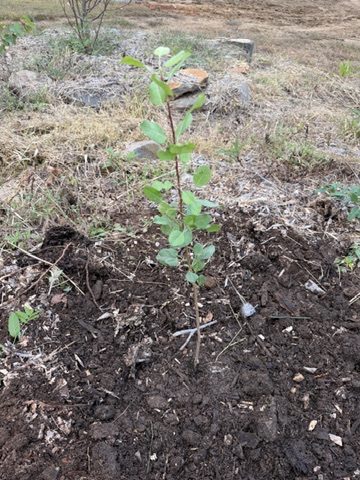
In early October 2026, our crew planted about 15 fruiting trees on a farm in Fauquier County, Virginia. The goal was simple and a lot of fun: a home orchard that feeds the family and feeds the local wildlife too. The lineup included apple, pear, plum, hazelnut, and mulberry, and every tree went in with the same careful site prep and protection.
If fruit tree tags that say “dwarf,” “semi-dwarf,” or “grafted on rootstock” leave you guessing, this guide is for you. Here is what rootstock is, why it matters, when to plant in Virginia, and how to prepare your site.
What Is a Rootstock Fruit Tree?
Most fruit trees you buy are really two plants working as one. The top part, called the scion, is the variety you want to harvest. The bottom part, the rootstock, provides the roots. The two are joined by budding or grafting, and the spot where they meet is called the graft union.
Why not just plant a seed? According to Virginia Cooperative Extension (VCE), apples and other tree fruits do not come true from seed. A seed from a Red Delicious apple would likely give small, poor-quality fruit. Grafting keeps the variety you chose, while the rootstock shapes how the tree grows.
When we plant, the trees usually look nothing like the orchard photos online. More often than not, a young tree arrives dormant with no leaves at all. That is exactly what you want at planting time.
One important note: not every fruiting tree is grafted. Apples, pears, and plums are typically grafted onto rootstock. Hazelnuts and mulberries are commonly grown from seed or cuttings on their own roots. A good planting plan accounts for both.
Benefits of Planting on Rootstock
 Size control
Rootstock is the biggest factor in how large a tree gets. VCE gives a clear example: the same apple variety can grow into a 16 to 18 foot tree on MM.111 rootstock, or a dwarf tree of 7 to 8 feet on M.9. Other rootstocks, such as M.26 and M.7, land in between. So you can match the tree to your space.
Earlier bearing
Rootstock also affects how soon a tree starts producing. VCE notes that apple trees on seedling rootstocks usually do not begin fruiting until they are 7 to 8 years old, while trees on M.9 will often produce crops in two to three years. In general, the more dwarfing the rootstock, the earlier the tree bears.
 Disease and pest considerations
Rootstock choice can influence how a tree holds up over time. VCE suggests specifying virus-free (EMLA) apple rootstocks and describes MM.111 EMLA as nearly problem-free. Resistance varies by rootstock, so ask your nursery how a specific one handles your conditions.
Soil adaptability and anchorage
VCE notes that trees on M.9 have brittle roots and must be given some type of support, such as a post or trellis. M.7 may need support for the first few years, while the more vigorous MM.111 does not require support.
Cold hardiness and longevity
Rootstock matters beyond apples. VCE’s peach guide notes that rootstocks can influence tree size, productivity, cold hardiness, and tree longevity, and that Lovell and Halford rootstocks have performed well in the Mid-Atlantic.
Choosing a rootstock
Start with your space, your soil, and the fruit you want. VCE also offers a clear caution for Virginia: dwarf pear, peach, and cherry trees are not recommended, because trees may not survive more than five years due to disease and incompatibility problems.
Best Time to Plant Fruit Trees in Virginia
Good news: VCE says Virginia conditions allow good results whether you plant in fall or early spring.
Fall planting
VCE generally recommends planting about a month after the first killing frost in the fall. Fall-planted trees can grow roots while the soil is still above about 40 degrees F, which gives them a head start before spring growth. The tradeoffs, according to VCE, include possible winter injury, frost heaving, and wildlife damage. That last one is a big reason we protect every young tree right away.
Early spring planting
The other window is about a month before bloom in the spring. Spring planting avoids a first winter in the ground, but it gives roots less time to settle before the growing season.
Why dormancy and soil moisture matter
Whichever season you choose, VCE stresses two things: the trees should be dormant, and the soil should have proper moisture.
How to Prepare Your Site
Site prep is where most fruit tree plantings succeed or fail.
Full sun and air drainage
Fruit trees want full sun. Just as important is air drainage. Cold air flows downhill like water, so VCE warns that fruit buds in low spots are more likely to be killed by frost than buds on a slope. Avoid frost pockets, low wet areas, and spots exposed to strong prevailing winds.
Soil drainage
VCE puts it plainly: moderately fertile soil is desirable, but deep, well-drained soil is vital. Poor fertility is easy to fix. Poor internal drainage is difficult and expensive to fix. If water sits in an area after rain, plant somewhere else.
Soil test and pH
Test before you plant. VCE recommends liming acidic soil to bring the pH between 6.0 and 6.5, and notes that, as a rule, no fertilizer is recommended or needed at planting time. The Virginia Tech Soil Testing Laboratory analyzes samples submitted by the public, and your local Extension office can provide sample boxes and help you read the results.
Spacing by rootstock size
Give each tree room to reach its mature size. VCE lists minimum spacing for home plantings, such as about 8 feet for dwarf apples, 18 feet for semi-dwarf apples, 30 feet for standard apples, and 20 feet for plums.
Planting depth: keep the graft union above the soil line
This is the rule we never break. Set the tree at about the same depth it grew in the nursery, and never so deep that the graft union ends up below ground level. When soil has been loosened, it settles, so we plant with that drop in mind. Never plant too deep.
Staking and support for dwarfing rootstocks
Trees on very dwarfing rootstocks such as M.9 need permanent support. Semi-dwarf trees may need support for their first few years.
Watering and mulch
VCE suggests adding water when the planting hole is about three-quarters full to settle soil around the roots, then finishing the fill. Keep weeds and grass from competing for moisture. Be careful with mulch: VCE notes that mulch can provide habitat for voles, so keep it pulled away from the trunk and check often. If watering by hand sounds like a chore, a simple drip setup from our plumbing and irrigation team can make it easier.
Our Dual-Purpose Planting of About 15 Fruiting Trees: Feeding Family and Wildlife
For this Fauquier County farm, the goal was to plant trees that would produce food for the family and also support local wildlife. The trees came from Whitetail Hill nursery and included:
- Non-Typical Apple
- Whitetail Hill Deer Pear
- Chickasaw Plum
- American Hazelnut
- Red Mulberry
Here is how we prepared each planting spot:
- Cleared weeds and grass around each spot.
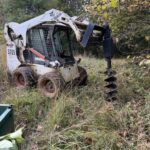
- Loosened the soil with an auger to about 14 inches deep. You do not need a deep hole; you need loose soil the roots can grow into.
- Mixed the backfill at roughly 30% compost with the native soil.
- Added mycorrhizal fungi from the nursery at planting.
- Set each tree so it was not too low, planning for the loosened soil to settle.
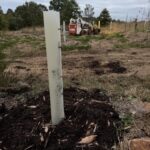
- Installed Tree Pro grow tubes for protection.
That is the same careful, step-by-step approach we bring to every tree and orchard planting project.
Choosing Trees That Serve Both the Table and Wildlife
Mixing grafted fruit trees with native, own-root species is a smart way to build a planting that feeds people and wildlife. North Carolina State Extension’s Plant Toolbox describes several of the species we used:
- Chickasaw plum is a native plum, usually a shrub up to about 15 feet, with small yellow-to-red fruit. NC State notes the fruit is eaten by songbirds, wild turkeys, quail, white-tailed deer, and small mammals, and the flowers support pollinators. The plums can be eaten fresh but are tart, and are often best in preserves and jellies.
- American hazelnut is a native, suckering shrub that grows about 9 to 12 feet tall. Its nuts are eaten by people and by a long list of wildlife. NC State also notes it suffers moderate deer damage, which is one more reason to protect young plants.
- Red mulberry is native to Virginia and the Mid-Atlantic and is easily grown from seed or cuttings. Birds love the fruit. It can be messy and can self-seed, so place it away from patios and driveways.
Pair these with apples and pears for the family table, and everyone eats.
Protecting Young Trees from Deer and Voles
New trees are an easy target. Penn State Extension notes that tree shelters, if tall enough, usually protect seedlings from deer browse. A 4-foot shelter is most common, and 5-foot shelters are recommended where deer pressure is severe. Shelters also guard against bucks rubbing their antlers on young trunks.
A few tips from Penn State Extension and our own experience:
- Stake them securely. Bucks may rub against shelters, and wind can knock over poorly anchored tubes.
- Seat them snugly to the ground, but not in it. A well-secured shelter can help keep voles, mice, and rabbits from girdling the trunk.
- Check inside periodically. Shelters can also harbor rodents, so look for damage or nests and keep weeds down around the base.
FAQs
What does “rootstock” mean on a fruit tree tag?
It names the root system your variety was grafted onto, which largely controls tree size, how early it bears, and anchorage.
Is fall or spring better for planting fruit trees in Virginia?
Both work. VCE recommends about a month after the first killing frost in fall or about a month before bloom in spring.
How tall will a dwarf or semi-dwarf apple tree get?
It depends on the rootstock: about 7 to 8 feet on M.9 up to 16 to 18 feet on MM.111, per VCE.
How soon will a tree on rootstock produce fruit?
VCE notes apples on M.9 often produce in two to three years, while trees on seedling rootstocks usually take 7 to 8 years. Results vary by variety, site, and care.
Should the graft union be above or below the soil?
Above. VCE advises never setting a tree so deep that the graft union is below ground level.
Do dwarf fruit trees need staking?
Very dwarfing apple rootstocks like M.9 need permanent support. Semi-dwarf M.7 may need support for the first few years. MM.111 typically does not.
What soil pH do fruit trees need?
VCE recommends a pH between 6.0 and 6.5. Test your soil before planting and lime if it is acidic.
Can I grow apricots in Virginia?
VCE does not recommend apricots for Virginia. Their buds respond to the first warm days of spring and are usually killed by frost.
Plan Your Fruit Tree Planting with Green Team Builders
Ready to grow your own fruit, feed local wildlife, or both? Green Team Builders can help you pick the right spot, prepare the soil, and plant and protect your trees the right way. Start with Plan Your Plot, learn more about our tree and orchard planting services, or contact us to talk through your project. Prefer the phone? Call 540-216-2395.
Sources
- Virginia Cooperative Extension, Tree Fruit in the Home Garden (426-841): https://www.pubs.ext.vt.edu/426/426-841/426-841.html
- Virginia Cooperative Extension, Growing Peaches and Nectarines in Virginia (422-019): https://www.pubs.ext.vt.edu/422/422-019/422-019.html
- Virginia Tech Soil Testing Laboratory: https://www.soiltest.vt.edu/
- NC State Extension Plant Toolbox: Prunus angustifolia (https://plants.ces.ncsu.edu/plants/prunus-angustifolia/), Corylus americana (https://plants.ces.ncsu.edu/plants/corylus-americana/), Morus rubra (https://plants.ces.ncsu.edu/plants/morus-rubra/)
- Penn State Extension, Tree Shelters: A Multipurpose Forest Management Tool: https://extension.psu.edu/forest-finance-7-tree-shelters-a-multipurpose-forest-management-tool